
Transfection is a cornerstone of molecular biology, enabling the introduction of plasmid DNA into mammalian cells for applications ranging from gene expression studies to synthetic biology workflows. While many transfection reagents are commercially available, lipid-based reagents remain the most widely adopted due to their efficiency, versatility, and compatibility with diverse cell lines.
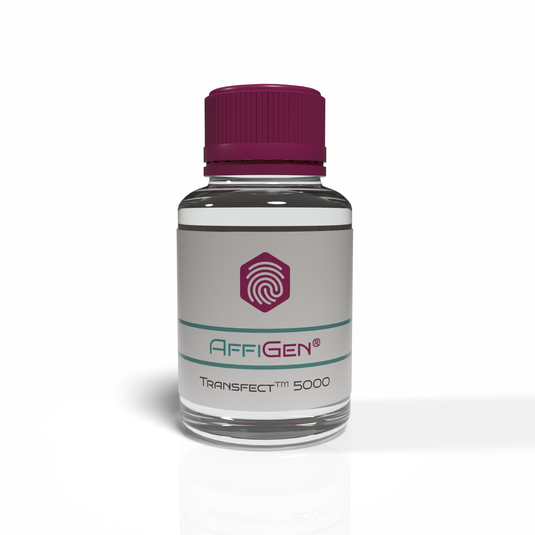
Among these, Transfect™ DNA In Vitro 5000 represents an optimized lipid formulation specifically engineered to improve DNA condensation, protect nucleic acids from degradation, and ensure efficient cellular uptake. Unlike protocol-focused instructions, this article explores the molecular and mechanistic basis behind why Transfect™ DNA In Vitro 5000 performs effectively, highlighting the physicochemical interactions that make it superior to many first-generation lipid reagents.
The Physicochemical Foundation of Lipid-Mediated DNA Delivery
DNA and Charge Neutralization
DNA is a highly charged macromolecule, with its phosphate backbone imparting a strong negative charge at physiological pH. This inherent polyanionic nature creates two challenges for intracellular delivery:
-
Repulsion from the negatively charged plasma membrane.
-
Susceptibility to degradation by extracellular and endosomal nucleases.
Cationic lipids, the active agents in Transfect™ DNA In Vitro 5000, address both challenges by:
-
Neutralizing DNA charge, condensing long plasmids into compact particles.
-
Shielding nucleic acids from enzymatic degradation.
Lipoplex Formation
When DNA is mixed with Transfect™ DNA In Vitro 5000, lipoplexes form spontaneously through electrostatic interactions. These nanoscale particles typically measure 100–300 nm, small enough for efficient cellular uptake.
Lipoplexes can take multiple structural forms depending on lipid composition and charge ratio:
-
Lamellar complexes: Alternating layers of lipids and DNA.
-
Inverted hexagonal phases: Non-bilayer structures that facilitate membrane fusion.
-
Multilamellar vesicles: More stable particles that protect DNA in serum.
The reagent’s optimized lipid ratios favor stable but fusogenic assemblies, balancing protection and release.
The Role of Helper Lipids in Transfect™ DNA In Vitro 5000
Cationic lipids alone can condense DNA but often form unstable or overly toxic aggregates. Transfect™ DNA In Vitro 5000 incorporates helper lipids (neutral or zwitterionic molecules such as DOPE-like analogs) that fine-tune physicochemical properties:
-
Membrane fluidity: Helper lipids reduce rigidity, promoting fusion with the endosomal bilayer.
-
Stability in serum: Zwitterionic lipids minimize aggregation in the presence of serum proteins.
-
Endosomal escape: Certain helper lipids favor non-lamellar phases that destabilize membranes.
This combination enhances both uptake efficiency and cell viability, a balance that is critical for reproducible results in sensitive cell lines.

Mechanism of Cellular Uptake
Step 1: Surface Binding
The positive surface charge of lipoplexes promotes adsorption to negatively charged molecules such as heparan sulfate proteoglycans on the cell surface. This initial step increases local concentration near the plasma membrane, making uptake more efficient.
Step 2: Endocytosis Pathways
Internalization occurs primarily through endocytic mechanisms:
-
Clathrin-mediated endocytosis: Common in many adherent mammalian cells.
-
Caveolae-mediated uptake: Favored in certain primary or non-dividing cells.
-
Macropinocytosis: A non-specific uptake route enhanced in transformed or cancer cell lines.
The use of multiple uptake routes increases the likelihood of successful delivery across diverse cell types.
Step 3: Endosomal Escape
After endocytosis, lipoplexes are sequestered in acidic endosomal compartments. Without release, DNA would be degraded by nucleases. Transfect™ DNA In Vitro 5000 is formulated with lipids that disrupt endosomal membranes through:
-
Proton sponge effect: Lipid components buffer the acidic environment, causing osmotic swelling and rupture.
-
Fusogenic phase transitions: Helper lipids promote hexagonal structures that fuse with endosomal membranes.
-
Electrostatic destabilization: Charge imbalance between lipoplexes and endosomal bilayers creates local curvature, opening transient pores.
This ensures DNA escapes into the cytoplasm before lysosomal degradation.
Step 4: Cytoplasmic Transport and Nuclear Entry
Once in the cytoplasm, plasmid DNA must reach the nucleus for expression. While nuclear entry is passive in dividing cells (during mitosis), in non-dividing cells DNA relies on nuclear localization signals and interactions with cytoskeletal transport pathways. The stability of DNA–lipid complexes provided by Transfect™ DNA In Vitro 5000 helps maintain DNA integrity until nuclear localization occurs.
DNA Protection and Stability
Nuclease degradation is a major barrier to transfection. Transfect™ DNA In Vitro 5000 improves DNA stability through multiple mechanisms:
-
Condensation into compact nanoparticles, making DNA less accessible to nucleases.
-
Encapsulation within lipid bilayers, forming a protective shield.
-
Serum compatibility, reducing aggregation caused by serum proteins in culture media.
This protection ensures that DNA remains intact from the point of complex formation through cellular uptake.
Advantages of Optimized Lipid Composition
Compared with early-generation cationic lipid reagents, Transfect™ DNA In Vitro 5000 introduces several improvements:
-
High efficiency across diverse cell lines — including primary and suspension cells.
-
Reduced cytotoxicity — by balancing cationic lipid density with helper lipids.
-
Stable lipoplex architecture — protecting DNA in extracellular environments.
-
Efficient endosomal escape — ensuring maximal nuclear delivery.
-
Compatibility with larger plasmids — optimized charge ratios support constructs >10 kb.
Comparative Insights: Why This Reagent Excels
Other lipid reagents often face trade-offs between efficiency and toxicity. For example:
-
Strongly cationic systems may condense DNA effectively but disrupt cellular membranes excessively.
-
Neutral lipids improve biocompatibility but reduce DNA binding affinity.
Transfect™ DNA In Vitro 5000 balances these forces through fine-tuned lipid chemistry, resulting in high reproducibility without compromising cell health.
Practical Case Studies
A. Reporter Gene Assays
In luciferase or GFP reporter assays, where signal intensity depends directly on transfection efficiency, the optimized formulation consistently yields higher expression levels compared with older lipid systems.
B. Large Plasmid Delivery
When delivering plasmids >12 kb, conventional reagents often show declining performance. Transfect™ DNA In Vitro 5000 maintains high efficiency due to its ability to condense and protect large constructs.
C. Library Screening
In pooled plasmid or CRISPR library applications, reproducibility depends on achieving uniform transfection across a cell population. The high efficiency and low cytotoxicity of Transfect™ DNA In Vitro 5000 make it well suited for these demanding workflows.
Visualization of the Mechanism
The transfection pathway can be summarized as a stepwise process:
-
Lipoplex formation (DNA + lipid reagent).
-
Surface binding to negatively charged membrane components.
-
Endocytosis through clathrin, caveolae, or macropinocytosis.
-
Endosomal escape via proton sponge effect, fusogenic lipids, and charge-driven destabilization.
-
Cytoplasmic release and nuclear entry, enabling transcription of the delivered plasmid.
This mechanistic cycle illustrates why Transfect™ DNA In Vitro 5000 achieves high efficiency with minimal toxicity.
Conclusion
Transfect™ DNA In Vitro 5000 is more than just a standard reagent. Its performance is rooted in molecular-level design, integrating charge-driven DNA condensation, helper lipid stabilization, fusogenic properties for endosomal escape, and compatibility with large or complex DNA constructs.
By moving beyond simple protocol steps and understanding the biophysical principles of lipoplex formation and cellular uptake, researchers can better appreciate why this reagent is effective across diverse applications. This mechanistic insight empowers scientists to make informed choices when planning experiments, improving reproducibility and maximizing success in transfection workflows.