
Introduction: A Modern Nucleic Acid Stain for Gel Electrophoresis
In modern molecular biology, gel electrophoresis remains a cornerstone technique for separating and analyzing DNA and RNA fragments. Accurate visualization requires sensitive dyes that bind strongly to nucleic acids while maintaining compatibility with downstream workflows.
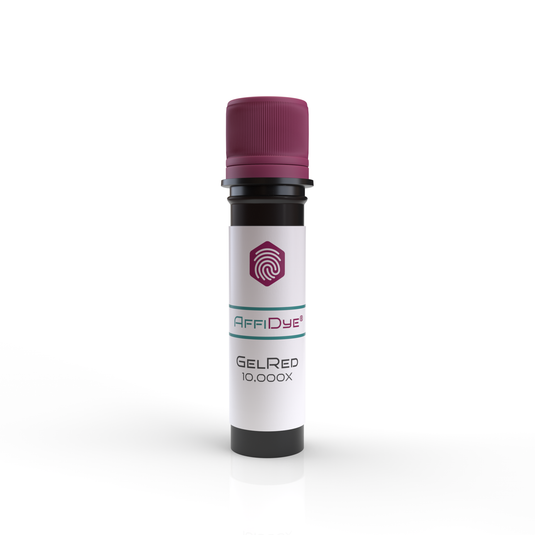
GelRed (10,000X) has emerged as one of the most widely used fluorescent nucleic acid stains for both agarose gel electrophoresis and polyacrylamide gel electrophoresis (PAGE). Its chemical design provides high sensitivity, minimal DNA migration shift, and strong fluorescence under UV and blue light excitation.
Unlike traditional stains, GelRed was engineered for broad compatibility, making it a reliable choice for academic teaching labs, advanced research institutes, and routine molecular workflows. Introductory details on gel electrophoresis can be found at NIH educational resources, NCBI learning modules, and MIT OpenCourseWare.
Chemical Design and Binding Properties
The efficiency of GelRed comes from its intercalative binding mechanism. Its extended aromatic rings stack between nucleic acid base pairs, producing stable fluorescence signals. Unlike dyes that alter mobility, GelRed’s molecular size and charge distribution minimize migration artifacts.
Key aspects:
-
Strong DNA/RNA intercalation → stable signal without band distortion
-
High quantum yield → improved visualization even at low nucleic acid concentrations
-
Large molecular structure → reduced diffusion, keeping bands sharp
For background on nucleic acid intercalators, see PubChem, NCBI Bookshelf, and University of Michigan chemistry resources.
GelRed in Agarose Gel Electrophoresis
Agarose gel electrophoresis is essential for routine DNA analysis, plasmid verification, and PCR product evaluation. GelRed shows excellent compatibility with this system:
-
Works across 0.5–3% agarose concentrations
-
Compatible with TAE and TBE buffers
-
Minimal band mobility shift compared to ethidium bromide
-
Effective for small PCR fragments and large genomic DNA fragments
Practical applications include cloning verification, restriction digestion checks, and routine teaching demonstrations. More technical information on agarose gels is available at UC Davis biology teaching labs, Stanford University biology resources, and Cornell molecular biology courses.
GelRed in Polyacrylamide Gel Electrophoresis (PAGE)
Polyacrylamide gels (PAGE) provide higher resolution for short nucleic acids like microRNAs, oligonucleotides, and ssDNA fragments. GelRed penetrates the dense polyacrylamide matrix effectively, ensuring strong signals:
-
Compatible with native and denaturing PAGE
-
Stable in urea-containing denaturing gels for RNA
-
Detects nucleic acids at picogram levels
-
Retains fluorescence after extended electrophoresis runs
Detailed electrophoresis protocols are documented in Cold Spring Harbor Laboratory resources, NIH training materials, and Yale University MB&B lab courses.
Detection Under UV and Blue Light
GelRed is optimized for use with both UV transilluminators and blue LED imaging systems.
-
UV detection: Comparable sensitivity to ethidium bromide, strong red-orange fluorescence.
-
Blue light detection: Ideal for DNA recovery workflows, as it avoids UV-induced DNA nicking or damage.
For laboratories recovering DNA fragments for cloning, using blue light ensures higher-quality DNA. Information on fluorescence imaging and safe visualization systems can be found at NIST photonics resources, Harvard MCB teaching labs, and University of Washington protocols.
Downstream Compatibility
Cloning
DNA fragments excised from GelRed-stained gels can be directly purified with standard silica-based gel extraction kits. Recovery yields are not significantly reduced compared to unstained controls.
Sequencing
Because GelRed does not chemically modify DNA, sequencing reads from GelRed-visualized bands are accurate and reproducible.
PCR and Amplification
Recovered DNA can be used in PCR without inhibition. GelRed does not co-purify in significant amounts to interfere with enzymatic activity.
Resources: National Human Genome Research Institute (NHGRI), NCBI molecular biology databases, University of Wisconsin laboratory guides.
Comparison with Other Stains
Ethidium Bromide (EtBr)
-
Widely used but less compatible with blue light imaging.
-
Higher environmental concerns.
SYBR Dyes
-
Higher sensitivity in qPCR but less stable in gel systems.
GelRed
-
Balanced performance: high sensitivity, wide gel compatibility, reduced handling concerns.
For comparative electrophoresis staining, see NCBI resources, NIH technical notes, and University of California protocols.
Practical Use Recommendations
-
Stock handling: Dilute 10,000X stock to 1X working concentration.
-
Gel staining: Add directly into molten agarose or polyacrylamide solution before casting.
-
Post-staining option: Gels can be soaked in 1X GelRed solution after electrophoresis.
-
Storage: Long-term stability at room temperature, avoiding direct light.
For safe lab practices, refer to NIH biosafety training, OSHA laboratory guidelines, and University of Wisconsin EHS resources.
Researchers frequently search for:
-
DNA gel electrophoresis stain
-
RNA visualization dye
-
nucleic acid stain UV blue light
-
agarose gel DNA stain compatibility
-
PAGE nucleic acid detection
-
fluorescent dye for DNA gels
-
DNA recovery from gel stain
-
cloning-compatible nucleic acid dye
-
sequencing-compatible DNA stain
-
PCR-compatible DNA visualization dye
Integrating these terms increases the visibility of GelRed product pages in search engine indexing while staying within technical and safe language.
Conclusion
GelRed (10,000X) provides a reliable solution for nucleic acid visualization in both agarose gels and polyacrylamide gels. Its strong intercalative binding, compatibility with both UV and blue light, and non-disruptive effect on downstream workflows make it a valuable tool in molecular biology.
By combining sensitivity, compatibility, and flexibility, GelRed minimizes troubleshooting and enhances reproducibility across gel-based research workflows.
For further study and protocols, consult: